

Last year, millions of people from nearly every country on the planet were united by a common purpose: to build a powerful global movement to solve the climate crisis.

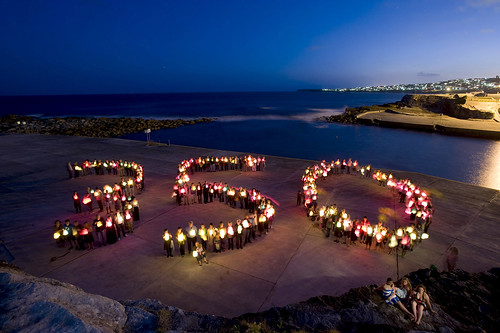
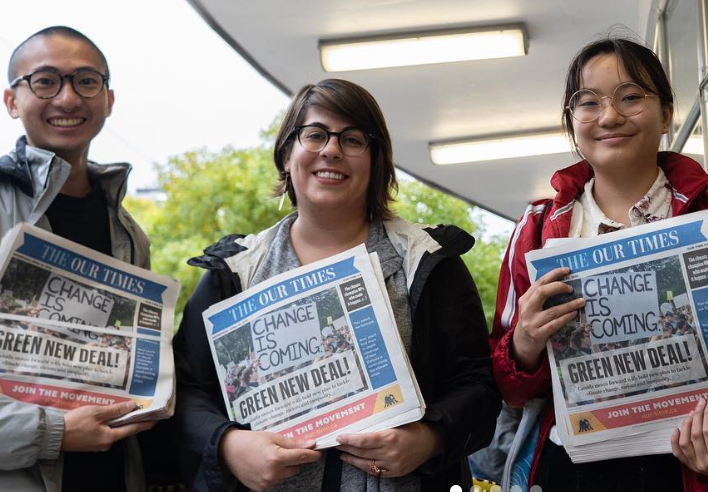
The slideshow on the left is just a sampling of the more than 25,000 photos of people uniting in a global call for 350, the safe upper limit of carbon dioxide in the atmosphere.

October 24th, 2009 was called "the most widespread day of political action in the planet's history," with more than 5200 events in 181 countries. We increased pressure throughout the Copenhagen climate talks: we lobbied inside, we protested outside, and we organized thousands of candlelight vigils with partners around the world.

But now the Copenhagen climate talks have come and gone, and we don't have the fair, ambitious, and binding treaty this global movement--and the latest science--demands.

But this is not over: 2010 will be a crucial year for the growth of the movement--and for its evolution. Please join us.


350 Updates

Third Graders Lead the Charge

Katie Swanson, the 3rd grade teacher at Calverton Elementary School in Beltsville, Maryland, USA,  has been a big 350 supporter . They drew pictures to send to the conference, and amazingly enough, Yvo de Boer, the chair of the UNFCC, emailed back to say that the one above will be projected behind the heads of state as they speak today in the plenary. It's a little embarassing to have to beg the leaders of the world to actually lead, but Sophie Dada, who drew the picture, is absolutely right to do it. Please!


Midday Update Copenhagen Time

We need you to keep posted--there will be an action alert inside of an hour.

For now:

1) Our champions are holding as strong as they can inside the Bella Center. Tuvalu, the Maldives, many of the African nations, and others will be speaking in the plenary today.

2) There is a spirited protest underway just outside the Bella Center, with arrests taking place. 

3) Our office here is calm but all-out busy. We're buoyed up by all your response and help from all over the world. Imagine great young people from across the world working their laptops, skype connections, and cellphones pretty much nonstop.


Only the numbers count—and they add up to hell on earth

Cross-posted from The Guardian

The Bella Center is a swirl of chatter, the streets of Copenhagen are a swirl of protest. Depending on what hour you listen to the news bulletin, the U.N. climate negotiations have “come off the rails” or are “back on track” or have “stalled” or are “moving swiftly.” Which is why the only people who really understand what’s going on may be a small crew of folks from a group of computer jockeys called Climate Interactive. Their software speaks numbers, not spin—and in the end it’s the numbers that count.

First number to know: 350. It’s what scientists have been saying for two years is the maximum amount of carbon dioxide we can safely have in the atmosphere, measured in parts per million. Those scientists have been joined by an unprecedented outpouring from civil society: in late October, activists put on what CNN called “the most widespread day of political action in the planet’s history,” with 5,200 demonstrations in 181 countries, all rallying around that number. Three thousand vigils last weekend across the planet spelled out the number in candles. Thousands of churches rang their bells 350 times on Sunday, and yesterday the World Parliament of Religions, meeting in Melbourne and representing the “largest interreligious gathering on earth” sent an emergency 350 declaration here to Copenhagen.

The second number: 100. That’s (roughly) how many countries are backing a 350 target here at Copenhagen. That’s more than half the nations in attendance—unfortunately, they’re the small, poor ones. But it’s amazing to see them, in the face of enormous pressure, keeping the idea of real action alive. Yesterday Mohamed Nasheed, president of the Maldives, spoke to a roaring crowd of thousands: “We know what the laws of physics say: the most important number in the world is 350.”

The third number: 4 percent. That’s how much the U.S. is offering to cut its emissions from their 1990 levels by 2020. Scientists tell us that the developed world would need to reduce by at least 40 percent to get us back on a 350 track, so the American offer is exactly an order or magnitude off. And they’re not alone. All the rich countries, not to mention China, are looking to do as little as possible and still escape here with some kind of agreement they can hide behind.

The fourth number—and the most important one. When the folks at Climate Interactive plug in every promise made at these talks (the American offer on the table, the Chinese promise to reduce “energy intensity”, the E.U. pledges, and so on) their software tells them almost instantly how much carbon they would eventually produce. When they hit the button last night, the program showed that by 2100 the world’s CO2 concentrations (currently 390) would be—drumroll please – 770. That is, we would live in hell, or at least a place with a similar temperature.

So that’s the scorecard. You may hear a lot of happy talk from world leaders over the next few days as they “reach a historic agreement.” But that’s how it all adds up.


Breaking: A Powerful Appeal from Desmond Tutu

I'm sitting in the middle of the Bella Center at the Copenhagen climate talks at 10:53 PM local time and just transcribed an incredibly powerful, printed letter from Archbishop Desmond Tutu that was sent to all heads of state and many top Christian leaders today. As far as we know, this letter hasn't been posted online before, so you're among the first people in the general public to see it. It's an important call to action from one of our most respected leaders and could have a big effect on the talks. I'll let the letter speak for itself: 

Your excellency,

I write urgently to you after meeting last night with the Chairperson of the G77 at his request. This is after the walkout from the UN Climate Talks which have deadlocked.

Ambassador Di-Aping showed me papers quoting from the IPCC’s 4th Assessment Report which declared that Africa is one of the most vulnerable continents to climate change and climate variability. In all four regions of Africa (West African, South African, East African, and Saharan), and in all seasons, the median temperature rise lies between 3 degrees C and 4 degrees C, roughly 1.5 times the global mean response.

Africa’s major economic sectors are vulnerable to current climate sensitivity exacerbated by factors such as endemic poverty, complex governance challenges, limited access to capital, infrastructure and technology as well as ecosystem degradation and other disasters and conflict.

If temperatures are not kept down then Africa faces a range of devastating threats such as crop yield reductions, in places of as much as 50%, in some countries by 2020; Increased pressure on water supplies for 70 - 250 million people by 2020 and 350 - 600 million by 2050; The cost of adaptation to sea level rises of at least 5 - 10% of gross domestic product.

I think this is common cause. We are facing impending disaster on a monstrous scale. To keep temperature increase in Africa to below 1.5 degrees C requires a global goal of less than 1 degree C; keeping it below 2 degrees in Africa would require a global goal of less than 1.3 degrees C. that is the crux of the matter. A global goal of about 2 degrees C is to condemn Africa to incineration and no modern development. And then of course there is the matter of funding mitigation and adaptation.

The Africans do not want to be spoilers. They know that we are in this together. We have but one earth home. If we do not reach a legally binding deal that takes account of all that has been outlined above then we are all doomed. We can swim or sink only together. The African group wants a deal, a fair ambitious and legally enforceable deal. If the issues that I have delineated above are not dealt with fairly and generously, attributes that have characterized most of the developed world, then it were better to have no deal than to have a bad deal.

This is a moral issue, it is a matter of justice for especially the weak and most vulnerable and the developed world is noted for seeking to do what is right and good.

I pray that my appeal to you will not fall on deaf ears.

God bless you,

Archbishop Emeritus Desmond Tutu.


Africa Will Not Be Sold!

So begins the first line of a statement from our friends at the Pan African Climate Justice Alliance. An hour ago, news came out that French President Sarkozy and Ethiopian Prime Minister Meles Zenawi reached a very weak agreement "on behalf of Africa." This agreement fell in complete contradiction to the strong positions of the African countries here in Copenhagen, and is quickly being denounced.

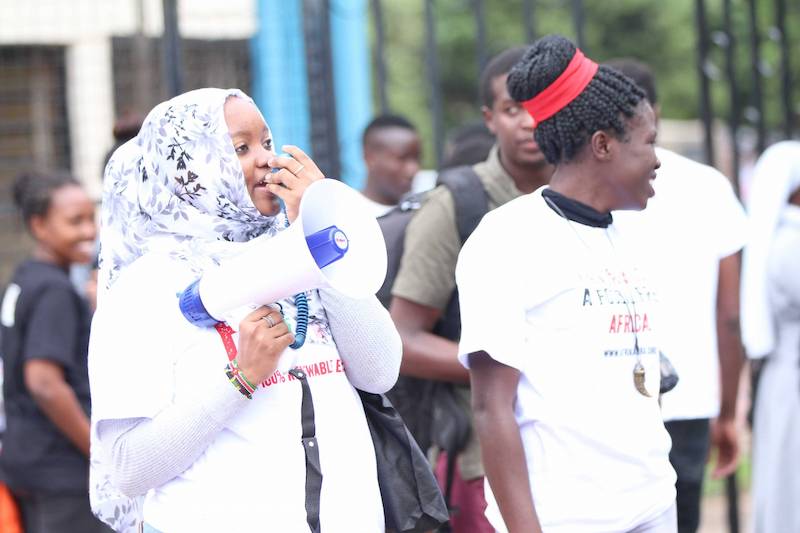
African countries have been some of the most vocal advocates for a 350 ppm agreement here in Copenhagen. They are absolutely on the front lines of climate catastrophe, and know their very survival is jeopardized as the planet continues to warm and developed country politicians fail to act. Outside the policy arena, hundreds of events took place throughout the continent on October 24. You can see some of  the most incredible photos here.

It's all the more disheartening to see Ethiopia taking part in this negotiation with France, as the largest October 24 event in the entire world took place in Addis Ababa. The two young women who organized the event, Tinebeb and Liyunesh, pictured here, came to Copenhagen and have been meeting with their delegations, briefing them on 350, and sharing tips and tools from the organizing work they have done.

We will keep you posted as to how this develops: we are very glad the 350 Africa movement is so strong and fighting back hard!


NEW VIDEO: The movement is awake...

Dear Friends,
Look what you did this past weekend:

Today in Copenhagen, President Nasheed of the Maldives gave a great speech. He said "my message to you is to continue the protests...continue despite the odds." He was talking to our collective movement, about your role in it--and he offered his advance thanks for your future leadership.

It's been a wild day here inside the Bella Center--the tension and the drama are ratcheting up almost by the hour. The "350 language" has been in and out of the draft text of the agreement half a dozen times, and our allies are doing their best to keep it in. You should have seen President Nasheed this afternoon making the case in front of an auditorium packed with members of the global media.

As the policy coordinator for 350.org, I spend most of my time lobbying--waiting in the hallways for meetings to end so I can speak to delegates and ministers as they walk to their next session. And what I hear, over and over again, is "You've changed the mood of the meeting." The relentless case you've made for the science of 350 has been extraordinarily effective--and it got a remarkable boost over the weekend from the thousands of vigils around the world.

Be sure to check out the video so you can see how this past weekend's efforts were echoed around the globe: http://www.350.org/vigil-vid

We apologize for bombarding you with emails. But we're going to send another one in the next 24 hours, summoning you to action one more time. 

To be honest, the plans are still evolving--and we want to wait for just the right moment to mobilize in the hopes of having maximum effect on these talks. Thank you so much for your continued dedication, and for having already having driven this process far beyond what most people thought possible.

Onwards,

May Boeve, for the entire 350.org Team

P.S. I'm pretty sure your friends, family, and co-workers will like this video too--even if they didn't take part last weekend.  It just takes 15 seconds--just click the links to spread the video on Twitter and Facebook.

Twitter: http://is.gd/5opix

Facebook: http://www.facebook.com/sharer.php?u=http://350.org/vigil-vid


Islands: No Retreat, No Surrender

Last night's rally with President Nasheed of the Maldives was just one of the ways we're working to help bulid momentum for island nations and others on the front-lines of the climate fight. It's the least we can do: island nations are coming under extraodinary pressure right now to back down off of 350 ppm and their proposals for a fair, ambitious and binding climate deal here in Copenhagen.

Pasted below is a great article that is getting printed in papers across the Caribbean right now. When we think of important media, we often think about CNN, the BBC, or the New York Times, but in politics, it's often the local news that matters most. To have a strong message of survival resonating throughout island nations is exactly what we need at this point, not just for the islands, but for all of us: 

No Retreat, No Surrender: Small Islands gaining support as they fight for survival

By Indi Mclymont-Lafayette and Horace Fisher

Panos Caribbean

Small islands states (including the Caribbean) jumped into the spotlight of the United Nations Climate Change discussions in Copenhagen, Denmark when they introduced their own draft text into the negotiations with tremendous support from another 53 non-island countries and the global lobby group, 350.org.

“We are on the frontlines of the climate change crisis – some of our islands will disappear... we accept that but we want an agreement that will ensure our survival,” Krispin Gregoire, the Dominican representative of the Alliance of Small Islands States (AOSIS) told journalists on Friday. He explained that AOSIS had done their own text to encourage further dialogue.

“We released... AOSIS proposal for the survival of the (Kyoto) protocol – as of now the (AOSIS position  - our text is seen as the basis for further talks,” he said. “We believe that with a week to go, there is plenty of time left. We want strong emissions reduction from all nations – all countries have a responsibility in this.”

The AOSIS document calls for legally binding agreements that will ensure the survival of the existing Kyoto Protocol on climate change as well long term action on the issues. It also covers major issues such financing, adaptation and technology transfer.

“We want predictable financing to finance insurance and measures to reduce risk from climate impacts,” said Gregoire.

“Today we have put forward a proposal for a legally binding agreement to secure the twin objectives of survival of the Kyoto Protocol and to strengthen the UNFCCC with a new ‘Copenhagen’ Protocol that can be adopted here in Copenhagen”, said Ambassador Dessima Williams of Grenada and AOSIS chair in a press release.

AOSIS has been advocating for developed countries to set stronger emission targets that would result in limiting global average temperatures to at least 1.5 degrees Celsius and also stabilising the greenhouse gas levels (especially carbon dioxide) to 350 parts per million. If these targets are not set, the small islands fear that their countries will disappear due to sea level rise and other climate impacts over the next 50 -100 years. Experts have already predicted that the Caribbean island of Barbuda will sink in about 60 years.

AOSIS concerns have been attracting international support from some of the other 192 countries that are part of the United Nations Climate talks going on in Copenhagen as well as global lobby group 350.org.

Read the entire article here.


North America

Just in from Melbourne

Where the Parliament of World Religions has been holding a giant gathering, the largest interreligious conclave on earth. Here's a clip of the message they sent to Copenhagen, calling for a 350 target in the strongest possible terms--the speaker is Bishop Geoff Davies of South Africa, a powerful preacher and environmentalist.


A Song for Survival

Sometimes all we need is a good tune to inspire us. Here's a song and email we just got from our friend Jonny Dubowsky


Hey gang-

I'm here on the Big Island of Hawai'i, where CO2 measurements are taken, and here in this place where land still forms in the ocean, and hope hangs from every ancient koa tree, i heard your call to action. To build an activist army for the small island nations (and the rest of the world) and bring attention to the survival pact that is being made as we speak, we need to mobilize our voices in unison "We will not die quietly, or lay our bodies down.We will not die quietly they'll put us in the ground. We will not die quietly and drown beneath the sea. We will not die quietly, survive, survive, survive!" Inspired by Bill's email today, and gearing up for tomorrow's candle-light vigils here on the Big Island, in Copenhagen, and around the world, I find myself in the recording studio finishing my 2nd Jonny Lives! record "Revolution For Free". The words and music came faster then ever before, and I give you this song to spread far and wide to all who will listen and sing along.

"We Will Not Die Quietly"
By Jonny Dubowsky of Jonny Lives"

If your like me your tired of all the lies that we've been told.
If your like me your hands are running out of rope to hold.
If your like me the rhetoric is stretching in your ears.
If your like me you haven't got the patience or the tears.

Chorus

And we will not die quietly and lay our bodies down.
And we will not die quietly, they'll put us in the ground.
And we will not die quietly and drown beneath the sea.
And we will not die quietly
Survive
Survive
Survive


Peak Moments

There have been a lot of them in this campaign, but we just came through one of the best. Mohammed Nasheed was the first head of state to arrive in Copenhagen, and his first public event was a giant rally for 350, which he drove into a frenzy, with a thousand people on their feet chanting 3-5-0. His entire speech was about 350, and he pledged that the "entire Maldives team is fighting to keep 350 in the negotiating text." Here's how he ended his speech, to the packed-out hall in the KlimaForum:

We know what the laws of physics say

And I think you know too

The most important number in the world.

The most important number you'll ever hear

The msot important number you'll ever say

These three words: Three-five-oh

Get blown away by the full speech here.


Stay tuned for how we take action. But for now, take pride in what you've set in motion